As I have thought about where I want to take this blog I have considered what sort of questions I should be asking, and of these questions which are the most important. In ruminating on this point it becomes obvious that the first thing to be done before continuing in my critique of specific Mormon and Catholic beliefs is to identify the most important differences between the faiths, since it is these differences that separate the two bodies. The following is a list of what I perceive to be the main differences between the LDS faith and traditional Christianity that also serves as an outline of posts to come. In these posts I will consider the different approaches each faith offers to these subjects and reveal what I believe to be the strengths and weaknesses of each respective approach.
Part II- the universe and its origin: This post will consider the ex nihilo (created from nothing) view of the universe held by Catholics (and most other contemporary Christians) and the LDS view that space, time, spiritual entities, and matter have always existed. The philosophical arguments pertaining to these views will be considered along with the historical understanding of the universe and its origins within Judaism and Christianity. Whether God created the universe has many further implications for issues such as the problem of evil.
Part III- God: Catholics view God as an unmoved mover that exists independent of space and time, whereas the LDS faith typically views God as a human being that has advanced to godhood. These views will be compared and critiqued.
Part IV- Heaven and Hell: Unlike the Catholic faith, which holds that human beings end up in either Heaven or Hell, members of the LDS faith tend to believe in an afterlife divided into three kingdoms, each better than our current existence, where humans will be assigned based on factors such as their acceptance of God and the choices they made as mortals; however, there has been wide speculation regarding the afterlife in Mormon thought.

Insights from Mormon-to-Orthodox Christian converts.
Showing posts with label LDS. Show all posts
Showing posts with label LDS. Show all posts
Wednesday, March 13, 2013

Thursday, March 7, 2013
The Catholic Claim to Apostolic Succession, and Catholic vs. LDS (Mormon) view of Apostolic Succession
 I recently encountered an argument from an LDS blogger that, other than Matthias and possibly Paul, the original twelve apostles didn't ordain a next generation of twelve apostles at all since, according to his view, the bishops and priests ordained in the early church should not be seen as successors of the apostles. In this post I will assess the Catholic claim to unbroken apostolic authority by consider the argument from LDS sources noted above as well as the argument that valid apostolic succession did take place but at some point was severed.
 What is apostolic authority?
The Catholic Church claims that, through St. Peter and the other apostles, Christ established a special apostolic authority for acting in his name for the preservation and growth of the Church. This authority includes binding and loosing, forgiving sins, and having power over demons (Matthew 16:19, 18:18; Luke 9:1). The attribute of apostolic succession most relevant to this post is the ability to ordain others for the mission of the Church. This is seen in Paul's Message to Titus:
This ordination process involved the laying on of hands as it is still done today in multiple apostolic denominations (1 Tim. 4:14).5 For this cause I left thee in Crete, that thou shouldest set in order the things that are wanting, and shouldest ordain priests in every city, as I also appointed thee:6 If any be without crime, the husband of one wife, having faithful children, not accused of riot, or unruly.7 For a bishop must be without crime, as the steward of God: not proud, not subject to anger, not given to wine, no striker, not greedy of filthy lucre.
Evidence of continuity?
Note: The exact dates and chronological order of the books in the New Testament have been disputed. For my dates I am using this source.
One may concede that apostolic authority and succession was implemented by Christ, and further that there was a structure and hierarchy preserved by this authority, but they may question the Catholic Church's claim of unbroken continuity. There may have been a line of apostolic authority and succession that was established and continued for a generation or two, but how do we know it continued beyond that? To answer this question, let us consider the records we have and their respective dates:
2 Cor 1: 21-22 (57 AD): Paul speaks of being confirmed, anointed, and sealed.
Acts 1:20-26 (64 AD): Matthias is ordained to fill Judas' bishopric.
Acts 14:23 (64 AD): Speaks of presbyters (priests) being appointed to each church.
Titus 1:5 (65 AD): Paul instructs Titus to ordain priests and bishops in the cities of Crete.
1 Tim. 4:14 (65 AD): Ordination given "with imposition of hands of the priesthood."
Heb 7:23 (67 AD): Verse speaks of other priests being called to replace those who have died.
Clement (98 AD):
"And thus preaching through countries and cities, they appointed the first-fruits [of their labours], having first proved them by the Spirit, to be bishops and deacons of those who should afterwards believe. Nor was this any new thing, since indeed many ages before it was written concerning bishops and deacons. For thus saith the Scripture a certain place, 'I will appoint their bishops s in righteousness, and their deacons in faith.'... Our apostles also knew, through our Lord Jesus Christ, and there would be strife on account of the office of the episcopate. For this reason, therefore, inasmuch as they had obtained a perfect fore-knowledge of this, they appointed those [ministers] already mentioned, and afterwards gave instructions, that when these should fall asleep, other approved men should succeed them in their ministry...For our sin will not be small, if we eject from the episcopate those who have blamelessly and holily fulfilled its duties." Pope Clement, Epistle to Corinthians, 42, 44 (A.D. 98).Ignatius (110 AD):
"For what is the bishop but one who beyond all others possesses all power and authority, so far as it is possible for a man to possess it, who according to his ability has been made an imitator of the Christ off God? And what is the presbytery but a sacred assembly, the counselors and assessors of the bishop? And what are the deacons but imitators of the angelic powers, fulfilling a pure and blameless ministry unto him, as…Anencletus and Clement to Peter?" Ignatius, To the Trallians, 7 (A.D. 110).... and the list continues here if you are interested.
There is abundant evidence that an apostolic structure that began during the ministry of Christ continued long after his death and resurrection; however we must acknowledge that it is technically possible that somewhere along the line one of these bishops or priests wasn't validly ordained, but for apostolic continuity to be completely severed there would have to have been a complete disappearance of validly ordained clergy. Given the spread of Christianity into various regions, a complete disappearance of apostolic authority seems unlikely. Further, such an event would contradict Christ's promise that "... I will build my church, and the gates of hell shall not prevail against it," (Matt. 16:18) and "...behold I am with you all days, even to the consummation of the world." Even if we disregard these verses, it is hard to believe God would establish an apostolic Church only to let it die.
Apostles aren't Bishops?
This is an argument I recently heard which is essentially that because the original apostles are only recorded as having ordained bishops, but not successors to fill the role of apostle, apostolic succession ceased. Underlying this argument is the idea that the early church had a priesthood office of "apostle" that was higher and distinct from that of bishop or priest. Put simply, apostolic succession stopped because the apostles ordained bishops, not apostles. However, there are two factors that I believe defeat this argument.
1. The idea that "bishop" and "apostle" are completely distinct from one another is refuted by Acts 1: 20, which states, referring to Judas ".. let his bishopric another take." Judas, who was an apostle, is also referred to as a bishop.
James, another of the original twelve apostles, is widely held to have been the first bishop of the Christian community in Jerusalem.
"...one cannot help but immediately focus on the figure of St. James the Just who, without question, functioned as the one-man monarchical leader of the Jerusalem city-church after the Apostles ceased to permanently reside there. Indeed, both Scripture and the universal witness of the Fathers illustrate this fact most clearly. For example, Eusebius of Caesarea, drawing from much earlier sources, directly states that the Apostles Peter, James [bar-Zebedee], and John appointed James the Just as the monarchical head ("bishop") of the Jerusalem city-church.2. This argument presupposes that, like bishop, apostle is a priesthood office. What is important to remember, however, is that the apostles were referred to as such prior to receiving priesthood authority; thus the word apostle cannot be necessarily tied to a priesthood office. The word apostle ("apostolos" in greek) means only "one who is sent." This definition is easily applied to both the original twelve apostles and the bishops and priests who were called and sent for the good of the Church.
Similarly, in Galatians 2:12, as St. Paul complains about some Judaizing Christians from the church of Jerusalem, he does not say that these Jewish brethren came "from Jerusalem" or from "the presbyters of Jerusalem," but rather "from James" -- thus equating James with the church of Jerusalem itself. Also, in Acts 12:17, as Peter flees Jerusalem after his miraculous escape from prison, he does not command the local flock to "report this to the presbyters"; but instead directly says, "Report this to James," thereby revealing that James was the leading authority." (source)
Conclusion
There are a few instances where there are minor absences of evidence for apostolic succession when the record is silent for a few decades, but there exists no evidence of the absence of a continuing apostolic structure. Further, there is nothing to suggest that the office of bishop is wholly distinct from the roles held by the original twelve apostles. In fact, there is evidence that some of the original twelve apostles were bishops. The term "apostle," meaning "one who is sent," is applied equally to apostles, bishops, and priests alike. There is no evidence that apostolic succession was severed, or that apostolic succession necessarily required the apostles to ordain other men who carried the title "apostle." Having established that there did indeed exist a structure of apostolic succession and ordination in the early Christian Church, the onus of proof is on those who doubt the Church's claim to unbroken apostolic succession.
Update (8 March 2013): Last night I ran into a Lutheran friend of mine, and we got to talking about this subject. As a Lutheran (ELCA), he believes in baptism, the celebration of the eucharist, and a church hierarchy; however, he does not believe in apostolic succession. Instead, he informed me that Lutherans (ELCA) believe the pastor assigned to each church merely fills an employment position of sorts in the church structure. Thus a priest does not have to celebrate communion or be ordained by other priests, strictly speaking. I thought I would consider this claim by examining the New Testament and Early Church Fathers along with the other claims already considered.
(My Friend's) Lutheran View of Apostolic Succession
First off, it is important to note that there is no uniform view of apostolic succession among Lutherans. Many churches in Scandinavia still hold apostolic succession as important and trace their authority back through pre-Reformation bishops. Therefore I will only be considering my friend's view of apostolic succession, being that it is unnecessary.
Power to Bind and Loose
In Matt. 16:19, Christ gives unto St. Peter the power to bind and loose, meaning that if he establishes something or discontinues something on earth it will also be so in heaven. Further, John 20:21-23 speaks of Christ sending his apostles and giving them authority to forgive or not forgive sins. If we do not understand this authority in the sense that apostolic churches understand it, as a priesthood authority, how else might we understand it?
Perhaps we could hold that the powers to bind, loose, and forgive sins belongs to the priesthood of all believers. This would mean than anyone who is a Christian possesses these powers. This poses a problem: what if some Christians want to bind, for instance, the admittance of women to the priesthood and other Christians are opposed to this binding? Who would have the final say? Perhaps we can conclude that when Christ told St. Peter that he would give him the power to bind, loose, and forgive he intended it to be a power of consensus by which Christians can vote on issues and make them official doctrines. It is important to acknowledge, however, that any time Christ speaks of giving authority to someone it is restricted to one or all of the apostles, not all believers.
While I believe the evidence up to this point remains in favor of the importance of apostolic succession it is not conclusive. Moving on, then, the next question to consider is whether the New Testament ever states that priests must receive authority from one already imbued with apostolic authority. In Ephesians 2:19-20, Paul speaks to the local community, saying "...you are fellow citizens with the saints, and the domestics of God, built upon the foundation of the apostles and prophets, Jesus Christ himself being the chief corner stone." This verse, along with Matt. 16:18-19, does imply that the church is founded upon the apostles to whom Christ gave special authority, but it may simply be interpreted to mean that Christianity is built upon the tradition preserved and declared by apostles and prophets. A reality that is difficult to overlook is that in every instant where someone is baptized, given the holy spirit, or given the authority to do these things it is done by Christ, the apostles, or one given authority from the apostles, such as Titus and Timothy (Acts 8:14-24; 1 Tim. 4:14, Titus 1:5).
The Old Testament further reveals a priesthood, established by God through Moses, that was exclusive and hierarchical as is the apostolic priesthood today (Exodus 18:25-26, 40:15; Numbers 3:3, 16:40, 27:18-20; Deut. 34:9).
Aside from the Bible, the Early writings of the Church Fathers reveal that apostolic succession and the episcopal structure of the Church was uncontroversial, and the very method by which one's authority was judged, as is demonstrated by this passage from Tertullian:
But if there be any (heresies) which are bold enough to plant themselves in the midst Of the apostolic age, that they may thereby seem to have been handed down by the apostles, because they existed in the time of the apostles, we can say: Let them produce the original records of their churches; let them unfold the roll of their bishops, running down in due succession from the beginning in such a manner that [that first bishop of theirs] bishop shall be able to show for his ordainer and predecessor some one of the apostles or of apostolic men,--a man, moreover, who continued steadfast with the apostles. …To this test, therefore will they be submitted for proof by those churches, who, although they derive not their founder from apostles or apostolic men (as being of much later date, for they are in fact being founded daily), yet, since they agree in the same faith, they are accounted as not less apostolic because they are akin in doctrine…Then let all the heresies, when challenged to these two tests by our apostolic church, offer their proof of how they deem themselves to be apostolic. But in truth they neither are so, nor are they able to prove themselves to be what they are not. Nor are they admitted to peaceful relations and communion by such churches as are in any way connected with apostles, inasmuch as they are in no sense themselves apostolic because of their diversity as to the mysteries of the faith." Tertullian, Prescription against the Heretics, 33 (A.D. 200).and further in this passage:
"Therefore the power of remitting sins was given to the apostles, and to the churches which they, sent by Christ, established, and to the bishops who succeeded to them by vicarious ordination." Firmilian, To Cyprian, Epistle 75[74]:16 (A.D. 256).There are many more passages such as these that can be accessed here and here.
Conclusion
There are many implicit evidences of apostolic succession found in the New Testament, such as priesthood authority being exercised only by the apostles and their successors. Further, the apostolic model of priesthood authority is akin to the Levitical priesthood structure found in the Pentateuch (first 5 books of Old Testament). Finally, the writings of the Early Church Fathers, as early as the first century, clearly show a Christian church that fully accepted the episcopal structure and the importance of apostolic continuity. Any Christian, or Christian body, that denies the importance of apostolic authority and continuity stands against the evidence presented by the early Church.
Wednesday, March 6, 2013
Joseph Smith's First Vision
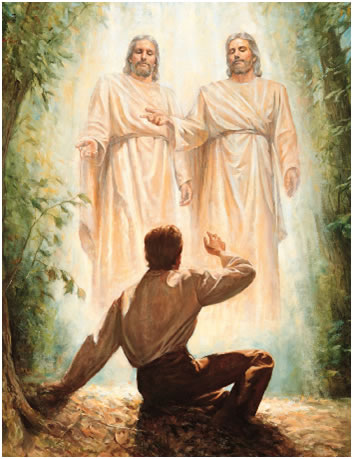 Note: Before I officially embark on this in-depth assessment of the truth claims of Catholicism and Mormonism, I wanted to first state the goals I have for this project. As I have explored the internet for arguments both for and against the claims of the Catholic and LDS faiths I have found that the arguments against them have often been uncharitable and unfair. Critics often lower themselves to relying on straw men and other deceptive claims about these traditions. My intention is to be as fair and charitable as possible in my assessments. I will seek to utilize only accurate evidence and the best arguments I can muster. As part of this intention I welcome and encourage those who may come across my posts to challenge and correct me where needed.
It has been difficult trying to figure out where exactly to begin assessing the claims of the LDS faith. Having failed to come up with any creative way to address the Mormon movement, I figured I would begin where the story begins chronologically. I will first provide the account of the first vision the LDS faith holds to be official. I will then consider some of the issues surrounding the First Vision account and then determine whether these issues are reconcilable with, or problematic for the position of the LDS faith.
The Official Version
The account of the First Vision taught by Mormon educators and missionaries reads as follows:
In accordance with this, my determination to ask of God, I retired to the woods to make the attempt. It was on the morning of a beautiful, clear day, early in the spring of eighteen hundred and twenty. It was the first time in my life that I had made such an attempt, for amidst all my anxieties I had never as yet made the attempt to pray vocally. After I had retired to the place where I had previously designed to go, having looked around me, and finding myself alone, I kneeled down and began to offer up the desires of my heart to God. I had scarcely done so, when immediately I was seized upon by some power which entirely overcame me, and had such an astonishing influence over me as to bind my tongue so that I could not speak. Thick darkness gathered around me, and it seemed to me for a time as if I were doomed to sudden destruction. But, exerting all my powers to call upon God to deliver me out of the power of this enemy which had seized upon me, and at the very moment when I was ready to sink into despair and abandon myself to destruction--not to an imaginary ruin, but to the power of some actual being from the unseen world, who had such marvelous power as I had never before felt in any being--just at this moment of great alarm, I saw a pillar of light exactly over my head, above the brightness of the sun, which descended gradually until it fell upon me. It no sooner appeared than I found myself delivered from the enemy which held me bound. When the light rested upon me I saw two Personages, whose brightness and glory defy all description, standing above me in the air. One of them spake unto me, calling me by name and said, pointing to the other--"This is My Beloved Son. Hear Him!" My object in going to inquire of the Lord was to know which of all the sects was right, that I might know which to join. No sooner, therefore, did I get possession of myself, so as to be able to speak, than I asked the Personages who stood above me in the light, which of all the sects was right (for at this time it had never entered into my heart that all were wrong)--and which I should join. I was answered that I must join none of them, for they were all wrong; and the Personage who addressed me said that all their creeds were an abomination in his sight; that those professors were all corrupt; that: "they draw near to me with their lips, but their hearts are far from me, they teach for doctrines the commandments of men, having a form of godliness, but they deny the power thereof." He again forbade me to join with any of them; and many other things did he say unto me, which I cannot write at this time. When I came to myself again, I found myself lying on my back, looking up into heaven. When the light had departed, I had no strength; but soon recovering in some degree, I went home. (Source: lds.org)This is the official version of the story that was firt recorded in 1838. I have highlighted select excerpts in red since they will be most relevant in considering possible issues with this vision.
Problems with the First Vision Story
A problem apparent from the above text, is that Joseph Smith claims to have experienced this vision in 1820, but the record above does not arise until 18 years later. In fact, the first recorded instance of Joseph Smith recording this vision is not until 1832:
...I cried unto the Lord for mercy for there was none else to whom I could go and to obtain mercy and the Lord heard my cry in the wilderness and while in (the) attitude of calling upon the Lord (in the 16th year of my age) a piller of fire light above the brightness of the sun at noon day come down from above and rested upon me and I was filled with the spirit of god and the (Lord) opened the heavens upon me and I saw the Lord and he spake unto me saying Joseph (my son) thy sins are forgiven thee. go thy (way) walk in my statutes and keep my commandments behold I am the Lord of glory I was crucifyed for the world that all those who believe on my name may have Eternal life (behold) the world lieth in sin and at this time and none doeth good no not one they have turned asside from the gospel and keep not (my) commandments they draw near to me with their lips while their hearts are far from me and mine anger is kindling against the inhabitants of the earth to visit them acording to th[e]ir ungodliness and to bring to pass that which (hath) been spoken by the mouth of the prophets and Ap[o]stles behold and lo I come quickly as it [is] written of me in the cloud (clothed) in the glory of my Father and my soul was filled with love and for many days I could rejoice with great Joy and the Lord was with me but [I] could find none that would believe the hevnly vision nevertheless I pondered these things in my heart … (Source: History, 1832, Joseph Smith Letterbook 1, pp.2,3)The first issue, and a minor one that I don't find very problematic, is that Joseph claims in the official version to have been 14 years of age, whereas in this version he claims to be in his 16th year, which can be interpreted to mean either that he was already, or going on, 16 years of age. Sometimes I forget exactly how old I was when something happened to me, too. Ultimately this minor discrepancy does not do much harm to Smith's claims.
The second issue, on the other hand, is quite problematic since Joseph Speaks of only one personage, the Lord, being present in this vision, and further idetifies him with Christ. Why is it, if the official version is accurate, that Joseph left out the crucial detail that two separate persons appeared to him in his first version? The Mormon apologist may argue that just because Smith doesn't mention a second person doesn't mean the second person wasn't there. I concede this possibility; however, there is a pivotal detail that many often overlook.
In the time preceding and even following the publication of the Book of Mormon in 1830, the evidence strongly suggests that Joseph Smith Jr. held a sabellian view of God, meaning he believed Christ and God the Father to be the same person. The Book of Mormon itself seems to speak of God in a sabellian fashion:
"And now Abinadi said unto them: I would that ye should understand that God himself shall come down among the children of men, and shall redeem his people. And because he dwelleth in flesh he shall be called the Son of God, and having subjected the flesh to the will of the Father, being the Father and the Son... And thus the flesh becoming subject to the Spirit, or the Son to the Father, being one God, suffereth temptation, and yieldeth not to the temptation..." (Book of Mormon, Mosiah 15: 1, 2, 5)
"Behold, I am he who was prepared from the foundation of the world to redeem my people. Behold I am Jesus Christ. I am the Father and the Son. In me shall all mankind have light... they shall become my sons and my daughters." (Ether 3:14)In light of these factors, Smith's first recorded account of his vision seems to fit perfectly well with the theology he held at the time. If he truly saw the two personages of Christ and God the Father in a vision, we are left to wonder why he left out such a crucial detail, and further, why the Book of Mormon speaks of God as one person rather than two. Further, history suggests that until 1835 the Mormon movement as a whole adhered to a sabellain view. (New Approaches to the Book of Mormon, 1993, pages 82, 96-99, 103-104, 110)
Further, unknown to many modern Mormons, is the fact that the official account of the vision did not begin to be taught until 1842 (source), 22 years after it supposedly happened, and 12 years after the publication of the Book of Mormon. This likely means that the Mormon movment prior to 1842 would have been grounded far less on the Joseph Smith's encounter with God, and instead on the Book of Mormon itself.
Other Visions of the Time
Another complication for Smith is that visions like his were not that uncommon in the early 1800s, and more troublesome still is that many of these other visions had striking similarities to his own:
"I saw two spirits, which I knew at the first sight. But if I had the tongue of an Angel I could not describe their glory, for they brought the joys of heaven with them. One was God, my Maker, almost in bodily shape like a man. His face was, as it were a flame of Fire, and his body, as it had been a Pillar and a cloud. In looking steadfastly to discern features, I could see none, but a small glimpse would appear in some other place. Below him stood Jesus Christ my Redeemer, in perfect shape like a man---His face was not ablaze, but had the countenance of fire, being bright and shining. His Father's will appeared to be his! All was condescension, peace, and love." (Norris Stearn, 1815)
"... I went into the woods ... a light appeared from heaven.... My mind seemed to rise in that light to the throne of God and the Lamb.... The Lamb once slain appeared to my understanding, and while viewing him, I felt such love to him as I never felt to any thing earthly.... It is not possible for me to tell how long I remained in that situation ..." (The Life, Conversion, Preaching, Travels, and Sufferings of Elias Smith, Portsmouth, N.H., 1816, pp.58-59)There have been multiple versions of Joseph Smith Jr's first vision that have been circulated far and wide. Some of the discrepancies between visions are minor, such as the exact day or year that he had the vision, while others are details that have serious theological implications. A further problem for Smith's account is that there are multiple vision accounts preceding Smith's that have striking similarities to his own. While there indeed seem to be a few crucial problems with the First Vision, perhaps LDS apologists provide insight into how Mormons can overcome these problems.
LDS Apologist Responses to First Vision Problems
From the official website of the LDS Church, Milton V. Backman Jr. writes the following:
The four surviving recitals of this theophany were prepared or rendered through different scribes, at different times, from a different perspective, for different purposes and to different audiences. It is not surprising, therefore, that each of them emphasizes different aspects of his experience. When Latter-day Saints today explain this remarkable vision to others, their descriptions often vary according to the audience or circumstances that prompt such reports. If one were relating the incident to a group of high priests, for example, he would undoubtedly tell it somewhat differently than he would to individuals who had never heard of the restoration of the gospel or of Joseph Smith...As I stated previously, there are certain discrepancies that I would expect and not make a big fuss about. If a Mormon was recounting the Smith's story and got the year wrong, for instance, I wouldn't think much of it. However, when an account differs in a significant, theological way and also happens to correspond with the view of God Joseph Smith Jr. held at the time of the recording, it seems unlikely that such a major detail as God the Father being present along with Christ would be left out simply due to forgetfulness. Further, this was not the only time that a record of Smith's visions differed significantly from the official version:
...Indeed, there are long-standing precedents for differing accounts of the same spiritual experience. For example, the four Gospels do not correspond exactly concerning the great events at the garden’s empty tomb. There are variations as to the number of women and angels who were present and whether the angels were sitting or standing. Although the Prophet Joseph Smith in his inspired translation clarified some of these details (and others cited below), minor disparities remain in the four descriptions of this event (compare Matt. 28 with Mark 16, Luke 24, andJohn 20). The differences, however, are not important—they may have resulted from incorrect transmissions or translations, or may be the result of recording the event from different perspectives. The glorious fact remains that the tomb was empty because Jesus had risen as the first fruits of the Resurrection.
 |
| http://www.mormoninfographics.com/2012/09/joseph-smiths-first-vision-and-his.html |
If there exist such extreme discrepancies between New Testament accounts, I would indeed be a hypocrite to hold them to a lesser standard, so let us consider whether there are any such discrepancies. Backman states that "There are variations as to the number of women and angels who were present and whether the angels were sitting or standing" and provides Matt. 28, Mark 16, Luke 24, and John 20 as examples. Let us look at these verses.
Matt: 28
In this account two women come to the tomb and one angel greets them.And in the end of the sabbath, when it began to dawn towards the first day of the week, came Mary Magdalen and the other Mary, to see the sepulchre.2 And behold there was a great earthquake. For an angel of the Lord descended from heaven, and coming, rolled back the stone, and sat upon it.3 And his countenance was as lightning, and his raiment as snow.4 And for fear of him, the guards were struck with terror, and became as dead men.5 And the angel answering, said to the women: Fear not you; for I know that you seek Jesus who was crucified.6 He is not here, for he is risen, as he said. Come, and see the place where the Lord was laid.
Mark 16
And when the sabbath was past, Mary Magdalen, and Mary the mother of James, and Salome, bought sweet spices, that coming, they might anoint Jesus.2 And very early in the morning, the first day of the week, they come to the sepulchre, the sun being now risen.3 And they said one to another: Who shall roll us back the stone from the door of the sepulchre?4 And looking, they saw the stone rolled back. For it was very great.5 And entering into the sepulchre, they saw a young man sitting on the right side, clothed with a white robe: and they were astonished.6 Who saith to them: Be not affrighted; you seek Jesus of Nazareth, who was crucified: he is risen, he is not here, behold the place where they laid him.7 But go, tell his disciples and Peter that he goeth before you into Galilee; there you shall see him, as he told you.
Once again, two women named Mary, and one being speaking to them. The only discrepancy is that this being is referred to as a man rather than an angel; however he is description sounds like that of an angel.
Luke 24
And on the first day of the week, very early in the morning, they came to the sepulchre, bringing the spices which they had prepared.2 And they found the stone rolled back from the sepulchre.3 And going in, they found not the body of the Lord Jesus.4 And it came to pass, as they were astonished in their mind at this, behold, two men stood by them, in shining apparel.5 And as they were afraid, and bowed down their countenance towards the ground, they said unto them: Why seek you the living with the dead?6 He is not here, but is risen. Remember how he spoke unto you, when he was in Galilee,7 Saying: The Son of man must be delivered into the hands of sinful men, and be crucified, and the third day rise again.
Two people go to the tomb once again. Given the earlier gospels it seems reasonable to assume that these two beings are the Marys. This time, however, the account speaks of two angelic beings.
John 20
And on the first day of the week, Mary Magdalen cometh early, when it was yet dark, unto the sepulchre; and she saw the stone taken away from the sepulchre.2 She ran, therefore, and cometh to Simon Peter, and to the other disciple whom Jesus loved, and saith to them: They have taken away the Lord out of the sepulchre, and we know not where they have laid him.
This seems like a condensed version of the three previous accounts, and this is no surprise, given that the Gospel of John is more of a theological than historical work. It would be akin a condensed version of Smith's account, such as "God the Father and Jesus appeared to me. Jesus told me not to join any of the churches in existence because they are all wrong."
Having put forward all these scriptural examples, let us now consider whether the discrepancies are on par with the serious discrepancies in Smith's accounts by first determining what are the most important aspects of these vision.
The central theme of the four gospel accounts above is that Christ is risen. The number of women present, or number of angels revealing this reality to the Marys does not change this key theme of the story. In other words, what is significant is not who came to the empty tomb, but that the tomb was found empty. Further, Backman acknowledges that these verses have had two thousand years to be altered and changed, which would give an additional reason as to why there are minor discrepancies.
In Smith's vision, the central theme, as the LDS church has promoted it, is that God and Christ have appeared to Smith and Christ has informed him that none of the religions are correct. It is important, given LDS theology, that the Father and Christ are identified separately. Thus anything that takes away from these important elements is a serious problem. Smith getting the day, year, or exact words Christ used when speaking to him would not change the central theme, but a change with theological bearings would. Hence, the discrepancies between Smith's accounts are more problematic than the discrepancies between the empty tomb accounts in the gospels.
An article from the (unofficial) LDS apologetics site FAIR puts forward the following argument:
The Reconstruction of Mormon Doctrine: From Joseph Smith to Progressive Theology" by Thomas G. Alexander
Conclusion
It has here been shown that there are issues with the First Vision accounts offered by Joseph Smith Jr. that may indeed be irreconcilable with the truth claims of the LDS faith. The arguments of the apologists I considered fail to make distinctions between minor discrepancies, and further, present claims that seems to run counter to the historical evidence. Even if one believes Joseph Smith Jr. really did experience a vision of the divine, or at least believes it possible, key questions remain:
1. Why doesn't Smith mention the Father in the 1832 account?
2. Why does the 1832 account of the first vision seem to coincide with the theological perspective Smith happened to have at the time? If Smith had really seen God and Christ as separate beings, why would both the Mormon movement and Smith continue to hold a view of God that varied from trinitarian to sabellian?
3. Why wasn't the First Vision taught in the LDS faith until 1842?
4. How do we account for the similarities Smith's vision has to visions that preceded his own?
5. Is it more likely that the discrepancies between the view of God in the Book of Mormon and the view of the Godhead held by the modern LDS faith is a result of ancient Mesoamerican authors having trinitarian/ sabellian views of God, or that it was penned by 19th century authors that lived in a Protestant America where trinitarian/ sabellian views of the Godhead were the norm?
For further reading on this topic as a whole, see the following:
"Joseph Smith’s Recitals of the First Vision" by Milton V. Backman, Jr.
Mormonthink on the First Vision
The central theme of the four gospel accounts above is that Christ is risen. The number of women present, or number of angels revealing this reality to the Marys does not change this key theme of the story. In other words, what is significant is not who came to the empty tomb, but that the tomb was found empty. Further, Backman acknowledges that these verses have had two thousand years to be altered and changed, which would give an additional reason as to why there are minor discrepancies.
In Smith's vision, the central theme, as the LDS church has promoted it, is that God and Christ have appeared to Smith and Christ has informed him that none of the religions are correct. It is important, given LDS theology, that the Father and Christ are identified separately. Thus anything that takes away from these important elements is a serious problem. Smith getting the day, year, or exact words Christ used when speaking to him would not change the central theme, but a change with theological bearings would. Hence, the discrepancies between Smith's accounts are more problematic than the discrepancies between the empty tomb accounts in the gospels.
An article from the (unofficial) LDS apologetics site FAIR puts forward the following argument:
Even though the Savior makes a direct reference to the Father there is no indication in this portion of the 1832 document that God appeared to Joseph Smith alongside His Son.The apologist here makes a good case for the belief that God and Christ being in some way distinct from one another is present in the Book of Mormon. What we are then left to ask is why other parts of the Book of Mormon speak of God and Christ as the same being. The Mormon may hold that such a discrepancy is easily accounted for, since the books comprising the Book of Mormon were penned by different authors who had different beliefs about God. Perhaps it is possible to reconcile the 1832 account with the 1838 if we grant that Smith did indeed hold the same view of the Godhead that Mormons now hold. However, evidence seems to suggest that this is not the case. As Thomas G. Alexander highlights, "...the doctrine of God preached and believed before 1835 was essentially trinitarian, with God the Father seen as an absolute personage of Spirit, Jesus Christ as a personage of tabernacle, and the Holy Ghost as an impersonal spiritual member of the Godhead." If this is indeed the case, then the FAIR apologist reaches too far in his defense by implying that God and Christ were seen as seperate in the modern Mormon sense. He instead might have used the word distinct or different.topic, see the following:
This type of pattern is seen in the Book of Mormon, translated in 1829: The Book of Mormon begins (1 Nephi 1:8-10) with Lehi's vision of God on his throne. One [Christ] followed by twelve others descends from God to speak with Lehi—thus, Jesus and the Father are here both separate, and the role of Christ in giving instructions to the prophet while the Father looks on and approves is followed, just as it was in Joseph's First Vision. Here too, Lehi is described as praying to "the Lord," and yet has a vision of both God the Father and Christ.
The Reconstruction of Mormon Doctrine: From Joseph Smith to Progressive Theology" by Thomas G. Alexander
Conclusion
It has here been shown that there are issues with the First Vision accounts offered by Joseph Smith Jr. that may indeed be irreconcilable with the truth claims of the LDS faith. The arguments of the apologists I considered fail to make distinctions between minor discrepancies, and further, present claims that seems to run counter to the historical evidence. Even if one believes Joseph Smith Jr. really did experience a vision of the divine, or at least believes it possible, key questions remain:
1. Why doesn't Smith mention the Father in the 1832 account?
2. Why does the 1832 account of the first vision seem to coincide with the theological perspective Smith happened to have at the time? If Smith had really seen God and Christ as separate beings, why would both the Mormon movement and Smith continue to hold a view of God that varied from trinitarian to sabellian?
3. Why wasn't the First Vision taught in the LDS faith until 1842?
4. How do we account for the similarities Smith's vision has to visions that preceded his own?
5. Is it more likely that the discrepancies between the view of God in the Book of Mormon and the view of the Godhead held by the modern LDS faith is a result of ancient Mesoamerican authors having trinitarian/ sabellian views of God, or that it was penned by 19th century authors that lived in a Protestant America where trinitarian/ sabellian views of the Godhead were the norm?
For further reading on this topic as a whole, see the following:
"Joseph Smith’s Recitals of the First Vision" by Milton V. Backman, Jr.
Mormonthink on the First Vision
Monday, February 11, 2013
Why only Mormonism and Catholicism? Pt. I: Introduction.
Given that there are several major religious movements in the world and many more sub-movements within these movements, it may be asked why I have decided to consider only these two faith traditions. A similar question is often posited by skeptics who rightly observe that one's religion is often no more than the result of where one happens to be born. This applies not only to those born into a specific faith, but converts as well. An American, for instance, may be more likely to become a Christian than Muslim due to prevalence, and additionally because of the less favorable view of Islam present in the West. My reason for considering both faiths seems to fit the skeptic's observation. I was born into a Mormon family and Culture, and the Catholic faith is the largest single Christian denomination in the world. Unlike some seek only reasons to further reinforce what they already believe, I have attempted to maintain as much impartiality as possible so that I may answer the question "Which faith tradition, if any, is true?"
The faith of my upbringing (Mormonism) remains part of my consideration because I was born into it, and I believe one should not part with the faith of their family, which is often of utmost importance, without very good reason for doing so. I believe such reasons can only be of two sorts: 1) A conviction that another faith tradition is true, or 2) A conviction that one's own faith tradition is false. Even in the case of the second, there are many individuals who, after losing faith, continue to participate in the practices and rituals of their respective tradition for social and familial reasons. In both cases, I believe leaving one's former faith should be a long and thoughtful process. There have been many who have reverted to the faith of their upbringing upon discovering that they never really gave it a thorough consideration. Thus I consider the Mormon faith to determine whether I have good reason for staying or parting.
The answer to "Why Catholicism?" requires a much longer answer which I am not sure how to begin. Partially underlying this question is the foundational query of this blog, being "How can one determine which faith is true?" I believe the best an individual can do is seek the faith that offers the best explanatory power to the universe and the human condition and all these things entail. To begin I will offer an outline of how I will go about answering the question, which is subject to change:
The answer to "Why Catholicism?" requires a much longer answer which I am not sure how to begin. Partially underlying this question is the foundational query of this blog, being "How can one determine which faith is true?" I believe the best an individual can do is seek the faith that offers the best explanatory power to the universe and the human condition and all these things entail. To begin I will offer an outline of how I will go about answering the question, which is subject to change:
- Pt. II is inspired by C.S. Lewis, who after becoming a Theist considered Judaism and Hinduism from which stem the other major world religions, ultimately concluding that Christianity is true. I too will provide my reasons for why I believe Christianity is true.
- Pt. III will be an account of why if Christianity is true I believe Apostolic Christianity must be true. Apostolic Christianity will include all faith traditions who see apostolic authority tracing back to the original apostles as necessary. These include the Anglican communion, the Assyrian Church of the East, Eastern Orthodox churches, the Mormon movement (including the RLDS), Oriental Orthodox churches, and the Catholic Church (East and West).
- Pt. IV will begin a consideration of why I believe the Catholic Church has a superior claim to truth over the other apostolic Christian churches (excluding the LDS faith) and will introduce my consideration of whether it has a superior claim to being the fullness of truth over the LDS faith.
Monday, February 4, 2013
The purpose of this blog
It is said that C.S. Lewis' "Space Trilogy" resulted from the dissatisfaction he and J.R.R. Tolkein had with the contemporary fiction. Unable to find any works they desired to read, they took it upon themselves to write such stories. My reason for writing does not stem from a desire for quality science fiction, but it does arise from an absence of the sort of resource I have sought in my religious journey. I aim to provide a thoughtful and impartial comparison of the truth claims of the Church of Jesus Christ of Latter-day Saints (Mormons) and the Roman Catholic Church (including Eastern churches in communion with the bishop of Rome) from the perspective of someone in the process of discerning between the two faiths.
Given that there are relatively few Mormons, or individuals of any faith for that matter, who ever seriously consider the truth claims of other religious groups, it is no surprise that such a project is rare, if not absent altogether. The internet has available many blogs and documents where individuals explain and/ or defend their own faith, and where individuals critique the truth claims of other faiths, but I have found that where these sources claim to take seriously the claims of other faiths, their arguments are often founded upon a priori assumptions that immediately set up the opponent for failure, or even worse still, many of the arguments I have encountered, whether they have been against Catholics or Mormons, have failed to confront the best apologists and arguments each respective faith has at its disposal.
In this blog I will compare the answers each faith offers to theological and ethical questions such as "On what basis should religious faith be founded?," "Does God exist within or apart from time?" and especially "Which Church has the best case for being the fullness of truth?"
I welcome input from anyone willing to contribute in a thoughtful and respectful fashion.
In this blog I will compare the answers each faith offers to theological and ethical questions such as "On what basis should religious faith be founded?," "Does God exist within or apart from time?" and especially "Which Church has the best case for being the fullness of truth?"
I welcome input from anyone willing to contribute in a thoughtful and respectful fashion.
Subscribe to:
Posts (Atom)